Hormoon betekenis latijn
hormon, Hormon zijn de beste vertalingen van "hormoon" in Latijn. hormoon noun neuter grammatica een stof die door een endocriene klier wordt afgescheiden en een bepaald effect veroorzaakt in het lichaam. Het woord hormoon is afgeleid van het Griekse hormáo dat 'in beweging zetten' betekent. Er zijn zeer uiteenlopende verbindingen die als hormoon kunnen worden geclassificeerd. 



Hormoon betekenis latijn Organisch product van een klier met een inwendige afscheiding aan de bloedstroom waarmee het wordt getransporteerd naar een ander voor het hormoon gevoelig weefsel of orgaan, waar het een specifieke werking uitoefent.
Hormone etymology
"organic compound produced in animal bodies to regulate activity and behavior," , from Greek hormon "that which sets in motion," present participle of horman "impel, urge on," from horme "onset, impulse," from PIE *or-sma-, from root *er- (1) "to move, set in motion.". Learned borrowing from Ancient Greek ὁρμῶν (hormôn), present participle of ὁρμάω (hormáō, “to set in motion, to urge on”), from ὁρμή (hormḗ, “rapid motion forwards, onrush, onset, assault, impulse to do a thing, effort”). hormone (plural hormones).- Hormone etymology hormone (n.) "organic compound produced in animal bodies to regulate activity and behavior," , from Greek hormon "that which sets in motion," present participle of horman "impel, urge on," from horme "onset, impulse," from PIE *or-sma-, from root *er- (1) "to move, set in motion.".
Greek origin hormone
"organic compound produced in animal bodies to regulate activity and behavior," , from Greek hormon "that which sets in motion," present participle of horman "impel, urge on," from horme "onset, impulse," from PIE *or-sma-, from root *er- (1) "to move, set in motion.". In , Sir Charles R. Harington in London performed the first chemical synthesis of a hormone, thyroxine. His breakthrough work was soon followed by the characterization of the nature and activity of the pancreatic hormone insulin—a protein—by Sir Frederick Grant Banting and Charles Herberg Best.Greek origin hormone A hormone (from the Greek participle ὁρμῶν, "setting in motion") is a class of signaling molecules in multicellular organisms that are sent to distant organs or tissues by complex biological processes to regulate physiology and behavior. [1].
Endocrine system
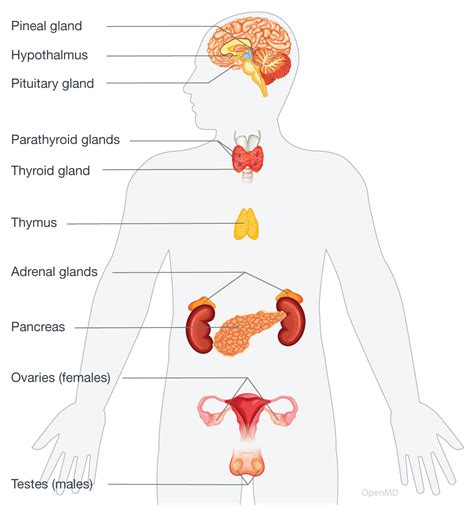
Your endocrine system is in charge of creating and releasing hormones to maintain countless bodily functions. Endocrine tissues include your pituitary gland, thyroid, pancreas and others. There are several conditions related to endocrine system issues — usually due to a hormone imbalance or problems directly affecting the tissue. The endocrine system helps regulate bodily functions through hormone secretion. Learn about the organs and hormones involved, as well as how they work.Endocrine system Learn about the endocrine system, a network of glands that produce and secrete hormones to regulate various functions in the body. Find out the structure, functions, and disorders of the major endocrine glands, such as the thyroid, pituitary, and adrenal glands.
Biochemical messengers
Cellular communication is a complex process involving various biochemical steps and many different messenger molecules between cells and organs. Cells in the human body are highly specialized, and they use various signaling mechanisms to perform different functions. Small molecules like nitric oxide (NO) and cyclic adenosine monophosphate (cAMP) play an important role as biochemical messengers. Cyclic adenosine monophosphate (cAMP): It works as a secondary.- Biochemical messengers The final chapters discuss the regulation of cell growth and division and the special case of messengers acting via nuclear receptors. The main argument of this book is that cell signalling via nerves, hormones, local mediators and growth factors are not distinct phenomena, but branches of.